
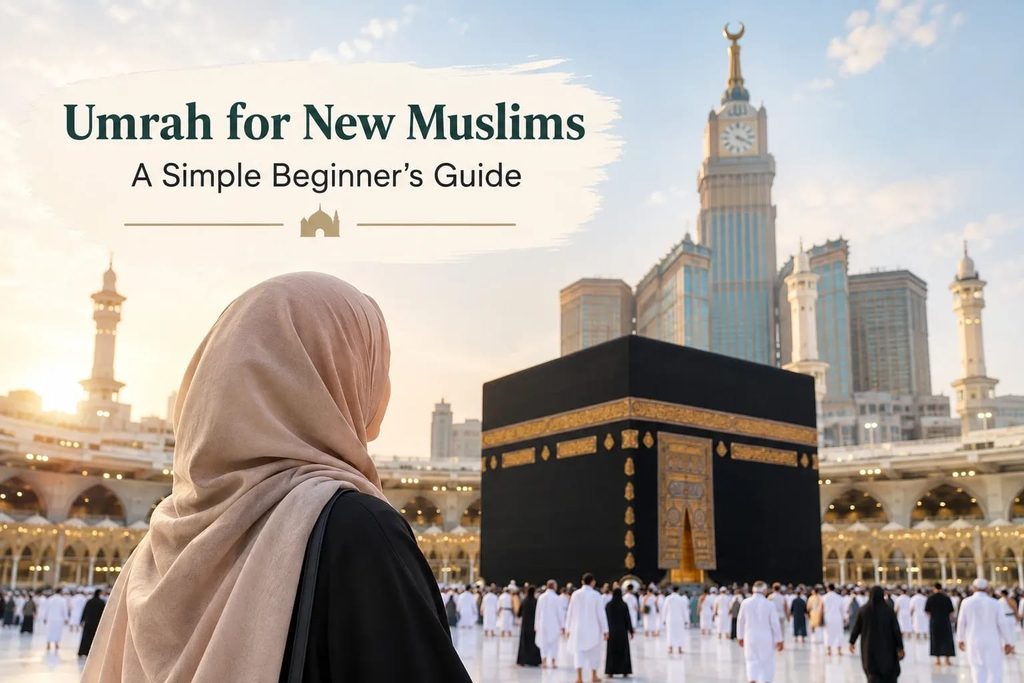
For a new Muslim, the idea of performing Umrah for New Muslims can feel both exciting and overwhelming. Visiting the sacred city of Makkah, standing before the Kaaba, performing Tawaf, and walking between Safa and Marwah can be an incredibly meaningful experience. At the same time, someone who has recently accepted Islam may have many questions: What exactly is Umrah? How is it performed? What should I learn before traveling? What should I say during the rituals?
The good news is that Umrah for New Muslims does not have to be complicated. With sincere intention, basic preparation, and an understanding of the Sunnah of the Prophet Muhammad ﷺ, a new Muslim can approach this spiritual journey with confidence, peace, and a heart full of gratitude. Preparing for Umrah for New Muslims becomes easier when you understand the essential rituals, travel requirements, and basic Islamic guidelines before beginning your journey.
This beginner’s guide explains the essential aspects of Umrah and highlights some of its spiritual lessons according to the Quran and Sunnah. New Muslims who want to strengthen their Quran reading and understanding can also explore Learn Quran Online with qualified teachers and structured lessons.
What Is Umrah?
Umrah is a pilgrimage to the Kaaba in Makkah that can be performed throughout the year. Unlike Hajj, which takes place during specific days of Dhul-Hijjah, Umrah does not have the same fixed annual period.
The Quran gives Muslims clear guidance concerning both Hajj and Umrah. Allah says:
“And complete Hajj and Umrah for Allah.”
(Quran 2:196)
This verse reminds Muslims that these acts of worship should be performed sincerely for Allah. For a new Muslim, this is one of the most important principles to understand: Umrah is not simply a journey to another country or a visit to a historic location. It is an act of worship.
Why Is Umrah Important?
Umrah gives Muslims an opportunity to worship Allah in the sacred environment of Makkah while following the example of Prophet Ibrahim (AS) and the Sunnah of Prophet Muhammad ﷺ.
The Prophet ﷺ also described the great virtue of Umrah. Abu Hurairah (RA) reported that the Messenger of Allah ﷺ said:
“An Umra is an expiation for the sins committed between it and the next…”
Sahih Muslim 1349a
For a new Muslim, this message can be particularly encouraging. Islam teaches that a person’s past is not a barrier to beginning a new life of faith. Allah’s mercy and forgiveness are central themes in Islam, and sincere worship provides an opportunity for spiritual renewal.
Preparing for Umrah for New Muslims
Preparation is especially important for someone who has recently converted to Islam. You do not need to know everything about Islam before performing Umrah, but you should learn the basic rituals and practical requirements beforehand.
1. Learn the Basic Steps
Before traveling, become familiar with:
- Ihram
- Miqat
- Talbiyah
- Tawaf
- Sa’i between Safa and Marwah
- Shaving or trimming the hair
- The restrictions of Ihram
Understanding these steps beforehand can reduce confusion when you arrive in Makkah.
2. Learn the Necessary Duas
New Muslims sometimes worry that they must memorize a large number of Arabic duas. This can make the experience unnecessarily stressful.
Learn the essential supplications associated with the rituals, but remember that worship is not limited to memorized Arabic phrases. You can also make sincere dua to Allah in a language you understand, asking Him for forgiveness, guidance, steadfastness, and goodness. The important thing is sincerity and following the authentic guidance of the Prophet ﷺ rather than becoming overwhelmed by unnecessary details.
Learning the basics of Islamic teachings can also help new Muslims feel more confident before their first Umrah. Islamic Studies Online can provide a structured way to learn essential Islamic knowledge.
3. Choose a Suitable Travel Arrangement
For first-time pilgrims, arranging flights, accommodation, transportation, permits where applicable, and other travel requirements can be challenging.
If you are traveling from Britain, researching an appropriate Umrah package from the UK can help simplify the organizational side of the journey. A suitable package may combine important travel arrangements so that a new Muslim can focus more attention on worship and preparation.
When comparing packages, carefully check what is included, the hotel location, transportation arrangements, duration of the trip, and any additional services.
Step-by-Step: How Is Umrah Performed?
Although some details require further study, the basic process of Umrah can be understood through a few major stages. This step-by-step guide to Umrah for New Muslims explains the main rituals in a simple and clear way, helping first-time pilgrims understand what to expect during their journey.
Step 1: Enter Ihram.
Ihram refers to the sacred state in which a pilgrim enters for Umrah. Before reaching the Miqat, the pilgrim prepares, makes the intention for Umrah, and begins reciting the Talbiyah.
The intention should be sincerely for Allah.
A common form of the Talbiyah is
Labbayka Allahumma labbayk, labbayka la sharika laka labbayk.
The pilgrim continues reciting the Talbiyah according to the established practice until approaching the Kaaba.
New Muslims should learn the specific Ihram rules before traveling, including what is prohibited while in Ihram.
Step 2: Perform Tawaf
After reaching Masjid al-Haram, the pilgrim performs Tawaf around the Kaaba.
Tawaf consists of seven circuits around the Kaaba, beginning from the area of the Black Stone.
During Tawaf, the pilgrim remembers Allah and makes dua. There is no need to panic about memorizing a special dua for every circuit.
The purpose is worship, remembrance, humility, and devotion to Allah.
For a new Muslim, seeing the Kaaba for the first time can be deeply emotional. It is an opportunity to remember that Muslims throughout the world turn toward this sacred House in prayer.
Step 3: Pray After Tawaf
After completing Tawaf, the pilgrim prays two units of prayer where possible and appropriate, following the established Sunnah and considering the circumstances and crowd.
Because Masjid al-Haram can become extremely busy, pilgrims should prioritize safety and avoid causing inconvenience to others.
Step 4: Perform Sa’i
The next major ritual is Sa’i, walking between Safa and Marwah.
This ritual commemorates the actions associated with Hajar (AS), the wife of Prophet Ibrahim (AS), who searched for water for her son Ismail (AS).
The story is a powerful lesson in trust, patience, and reliance upon Allah.
The pilgrim completes seven trips between Safa and Marwah, beginning at Safa and finishing at Marwah.
For a new Muslim, Sa’i can serve as a reminder that hardship does not mean Allah has abandoned a person. Hajar (AS) continued her efforts while trusting Allah, and Allah provided from where she could not have expected.
Step 5: Cut or Shave the Hair
After Sa’i, the final major step is cutting or shaving the hair.
Men generally shave or shorten their hair, while women trim a portion of their hair according to Islamic guidance.
Once this is completed, the Umrah is finished and the restrictions of Ihram come to an end.
Important Sunnah Lessons for New Muslims
Umrah is not only about completing physical rituals. It should also influence a Muslim’s character and relationship with Allah.
Sincerity Comes First
Every act of worship should be performed for Allah. A person should not perform Umrah merely for photographs, social recognition, or praise from others.
The Prophet ﷺ taught that actions are judged according to intentions. Therefore, a new Muslim should regularly renew their intention and ask Allah to accept their worship.
Follow the Prophetic Example
The Prophet Muhammad ﷺ demonstrated how the pilgrimage should be performed, and Muslims should try to learn the rituals from authentic sources.
The Sunnah should make Umrah easier rather than turning it into an unnecessarily complicated experience.
Practice Patience
Makkah can be crowded, especially around the Haram. You may experience queues, delays, tiredness, heat, or difficulty finding your group.
These situations provide an opportunity to practice sabr, or patience.
A pilgrim should avoid arguments and harsh behavior and instead remember that the purpose of the journey is worship.
Umrah and Ramadan
Some new Muslims may consider performing Umrah during Ramadan because of the special virtue associated with it.
The Prophet ﷺ said that Umrah during Ramadan has a reward equivalent to Hajj in reward, as reported in Sahih Muslim.
However, this does not mean that Ramadan Umrah replaces the obligation of Hajj for someone who is required to perform Hajj. The two are distinct acts of worship.
Because Ramadan can be extremely busy, anyone considering this journey should prepare carefully and make arrangements well in advance.
Common Mistakes New Muslims Should Avoid
A first Umrah can involve a lot of information, and beginners may become concerned about making mistakes. Some useful principles include
Do Not Become Overwhelmed
You are learning. Take time to study the essential rituals before traveling instead of trying to memorize everything at once.
Do Not Invent Rituals
Follow the Quran and authentic Sunnah rather than assuming that every cultural practice associated with Umrah is a religious requirement.
Do Not Neglect Other Muslims
Be considerate toward other pilgrims. Avoid pushing, arguing, blocking pathways, or unnecessarily delaying people.
Do Not Focus Only on Photographs
Taking a few memories may be understandable, but the primary purpose of Umrah is worship. Try to keep your heart focused on Allah.
Getting Help With Your Umrah Journey
New Muslims may benefit from traveling with experienced family members, friends, knowledgeable guides, or a reputable Umrah service provider.
A service such as Hajj Umrah Hub may be useful for people researching pilgrimage arrangements and looking for guidance about organizing their journey.
However, travel arrangements and religious guidance are two different things. Before relying on any particular religious instruction, new Muslims should verify it against the Quran and authentic Sunnah and, when necessary, ask a qualified scholar.
What Should a New Muslim Take Away From Umrah?
The greatest benefit of Umrah should not end when the airplane lands back home.
The journey should encourage a Muslim to continue praying, reading the Quran, remembering Allah, improving their character, and maintaining the connection with the Muslim community. For Umrah for New Muslims, building a strong foundation in Islamic knowledge can be helpful. New Muslims can continue learning through Basic Islamic Education
Umrah can also teach important qualities such as patience, humility, gratitude, discipline, and trust in Allah.
For someone who has recently accepted Islam, the journey can represent a new chapter. However, becoming closer to Allah does not depend on one extraordinary moment. It develops through consistent worship and sincere effort every day.
Final Thoughts
Umrah is a beautiful act of worship and a meaningful spiritual journey. For new Muslims in the UK, it may seem overwhelming at first, but learning the basics of Ihram, Tawaf, and Sa’i can make the experience much easier.
Prepare carefully for your journey from the UK, including your travel, accommodation, and other arrangements, while keeping your intention sincerely for Allah. Follow the Quran and authentic Sunnah, and seek guidance from trustworthy scholars when needed. With proper preparation and sincere intention, Umrah for New Muslims can become a meaningful step toward building a stronger connection with Allah.
May Allah accept the Umrah of every pilgrim, make their journey safe and easy, strengthen their faith, and make it a source of lasting guidance and blessings. Ameen.